If you trade Brickell condo prices in your head the way New Yorkers trade Park Avenue blocks, the next entry on your spreadsheet should probably be a corner you’ve never heard of: Av. Pezet and Av. Coronel Portillo, in San Isidro, Lima’s financial-residential heart. Robert A.M. Stern Architects (the firm behind 15 Central Park West) is finishing a 25-story project at Pezet 195 San Isidro. Three blocks away, Carlos Ott — designer of the Opéra Bastille in Paris and Echo Brickell in Miami — is closing out The Grand, a 22-story tower wrapping around a curved facade above the Lima Golf Club. The South Pacific just got its own architectural gold mile, and Latin American buyers in Miami, Madrid and Houston are starting to notice.
What you’ll find in this guide
- Why Pezet–Choquehuanca and not classic El Golf
- Anchor towers: Pezet 195, The Grand and the rest
- The architects redrawing the corridor
- Price per sqm, entry tickets and how the corridor splits
- De Lujo Real Estate, Octagon and the early bets
- Old gold mile vs. new: what changed
- Who’s buying in Pezet–Choquehuanca today
- Risks, zoning ordinances and what’s still pending
- Frequently asked questions
Why Pezet–Choquehuanca and not classic El Golf
For decades, the luxury conversation in San Isidro started and ended at El Golf — the Aurelio Miró Quesada block, the houses facing the Lima Golf Club, the upper Choquehuanca lots near the Country Club Lima Hotel. All of that is still there. What changed is the center of gravity. The new architectural mile runs along Av. Pezet from the Lima Golf Club down to its corner with Coronel Portillo, then turns onto Av. Choquehuanca toward Camino Real, branching out through cross streets like Coronel Portillo, El Rosario, Los Eucaliptos and Jacinto Lara. It’s the same perimeter that historically held three-story single-family residences. Today it holds 22-story towers, eight-unit boutique buildings and projects signed by architects who also build in Brickell, Paris and Dubai.
Three engines drove the transformation. First, zoning: the Municipalidad Metropolitana de Lima updated maximum heights in San Isidro sub-zones, allowing buildings of up to 18 floors along part of the Choquehuanca–Camino Real axis (per La Razón coverage of the municipal debate). Second, land supply: large lots with old single-family mansions sold at prices that justified demolition and vertical development. Third, the buyer: local investors with tickets above US$800,000, Peruvians living in Miami who started looking back at Lima after the 2024 rebound, and families relocating within the same district all converged on the same polygon.
If you want broader district context, our piece on Lima’s exclusive districts sets the stage. This article zooms in on a specific polygon: the Pezet–Choquehuanca corridor, where the architects arrived before the buyers did.
Anchor towers: Pezet 195, The Grand and the rest
Pezet 195: Robert A.M. Stern brings prewar Manhattan to Lima
Pezet 195 San Isidro put the corridor on the international architectural map. The signature belongs to Robert A.M. Stern Architects (RAMSA), the New York firm known for buildings like 15 Central Park West and 220 Central Park South. The complex is two 25-story residential towers — 94 meters tall — plus a smaller eight-story volume facing Roosevelt Park. Brick and limestone, prewar vocabulary adapted to the Lima sky. Units start at roughly 250 sqm (about 2,690 sq ft) and scale up from there. The firm’s public project description tells the same story: bringing the grammar of the 1920s New York apartment building to the South Pacific, with the Lima Golf Club functioning as the building’s main facade. The project appears in RAMSA’s official portfolio under the name “Pezet 195.”
The Grand: Carlos Ott’s curve over the golf course
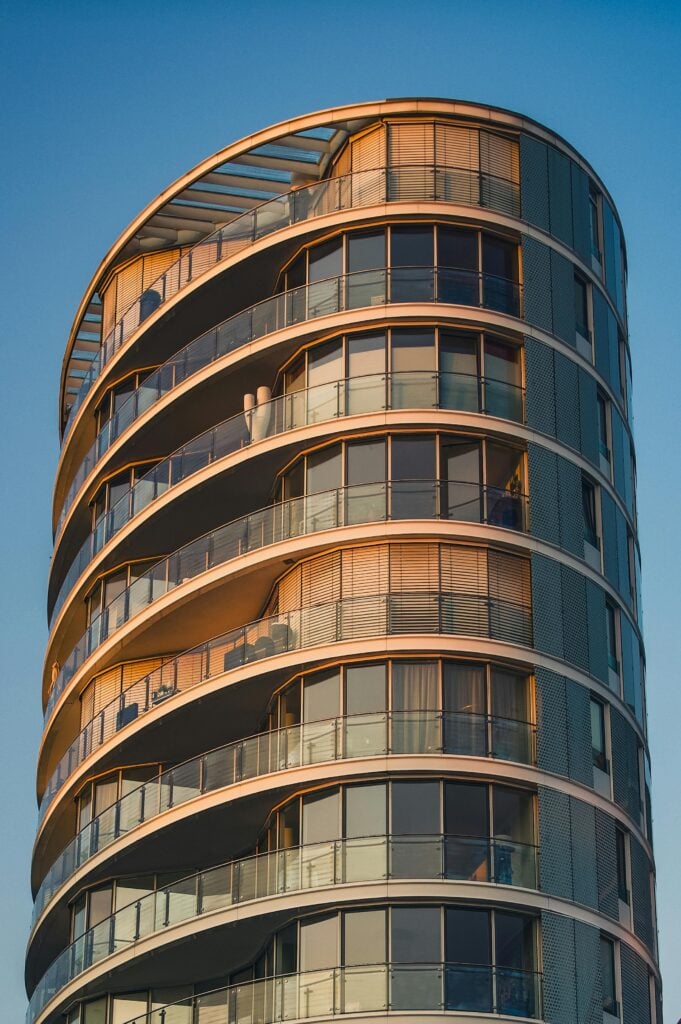
The Grand sits three blocks south, at the corner of Av. Pezet and Av. Coronel Portillo. Developed by Grupo Octagon, it carries the signatures of Carlos Ott and Carlos Ponce de León. Twenty-two floors, more than 70 meters of height, a curved facade with balconies that shift level by level. Apartments range from 150 sqm to 310 sqm (about 1,615 to 3,335 sq ft), with flat, duplex and penthouse layouts, and pricing the developer has placed between US$500,000 and US$2.1 million according to public materials and Día1 (El Comercio) coverage. Delivery is scheduled for Q4 2025; by the time El Comercio’s Día1 supplement covered the project, more than 60% of units had sold and an Audi co-branding partnership had been added as a marketing differentiator. The full project deep-dive lives in our monographic on The Grand flat apartments.
LIF Pezet, Eucaliptos, Jacinto Lara: the second ring
The corridor isn’t reduced to those two icons. LIF Pezet is a project on the same avenue with units starting at 178.78 sqm (1,925 sq ft) in flat, duplex and penthouse formats, with views of the Lima Golf Club. Edificio Eucaliptos sits at Calle Los Eucaliptos 383, deep in the Choquehuanca zone, with 43 apartments, four penthouses and three garden houses, all park-facing. The Jacinto Lara project — designed by Peruvian firm 51-1 Arquitectos and marketed by De Lujo Real Estate — slips into the cross street next to Calle Dasso, adding one more piece to the network. Each one targets a different buyer: the investor wants the golf view; the family wants the park; the young executive wants boutique instead of tower.
The architects redrawing the corridor
What sets this mile apart from the rest of Lima Top isn’t just the ticket. It’s the roster of firms. In less than a kilometer, three distinct architectural languages cross paths.
Robert A.M. Stern Architects. Manhattan-based studio. RAMSA’s portfolio runs from Yale University campus buildings to Park Avenue residential towers. At Pezet 195 San Isidro they work the prewar building vocabulary: brick, limestone, vertical windows, setbacks, cornices. The aesthetic promise is historical continuity, not rupture.
Carlos Ott. Uruguayan-Canadian architect, winner of the 1983 international competition for the Opéra Bastille in Paris, designer of the Banque Nationale de Dubaï and of Brickell-area residential towers (Jade Ocean, Echo Brickell). At The Grand he allows himself the curve, the staggered balconies and a profile that breaks with the corridor’s orthogonal verticality. He partnered with local architect Carlos Ponce de León for technical delivery and with Jordi Puig and Claudia Paz for interior design and lighting.
51-1 Arquitectos. Contemporary Peruvian studio with internationally recognized work. At Jacinto Lara they bring the local counterpoint: boutique building, more intimate scale, Peruvian material vocabulary, attention to artisanal detail. The firm proves a key thesis of the corridor: not everything here needs a foreign brand to sustain the ticket.
The urban consequence matters. For the first time in Lima, a single block can show you three valid answers to the same question — how to build residential luxury on a historic axis — signed by teams that also compete in Manhattan, Brickell and the Côte d’Azur. That geographic concentration of authorship is what turns the corridor into an actual gold mile and not just an expensive cluster.
Price per sqm, entry tickets and how the corridor splits
The hard numbers help explain why so many premium projects clustered here. San Isidro Sur — the sub-district covering the Lima Golf Club zone, the upper Pezet blocks and the polygon facing the Country Club — closed May 2025 with an average value of S/11,984 per square meter (around US$3,200) per the Urbania Index Lima, ranking as the most expensive zone in all of Metropolitan Lima. The city average for the same date sat at S/6,816 per sqm. The mile, in other words, prices about 75% above the metropolitan average.
What matters is that the sub-district average is exactly that: an average. In the Pezet–Choquehuanca corridor, ticket prices skew well above. At Pezet 195 San Isidro, market chatter places the per-sqm number around US$5,000, putting the smallest apartment near US$1.25 million. At The Grand, the developer’s official range goes from US$500,000 for compact flats to US$2.1 million for duplexes and penthouses with golf and Pacific views. At LIF Pezet and Eucaliptos, entry tickets dip slightly by typology and location, but all play in the US$700,000–US$1.5 million range for a standard unit. By Brickell standards, that range buys you a comparable square footage with a much lower HOA and far less inventory competition.
How the corridor splits by ticket
- Facing Lima Golf Club (upper Pezet): US$1.2M–US$3M. Premium tickets, unique views, scarce supply.
- Pezet–Coronel Portillo (The Grand block): US$500,000–US$2.1M. Greatest typology variety, branded auto partnership at a flagship unit.
- Choquehuanca near Camino Real: US$700,000–US$1.4M. Mid-size buildings, established family profile.
- Cross streets (Eucaliptos, Jacinto Lara, El Rosario): US$600,000–US$1.1M. Boutique 8–16 units, careful design.
If you’re benchmarking against the broader district picture, cross-reference with our Lima Top price per sqm index 2026. The takeaway: the Pezet–Choquehuanca corridor pays a premium over its own sub-district average. The conversation with your broker shouldn’t start with “what does San Isidro cost per sqm” but with “what does that specific block cost.”
De Lujo Real Estate, Octagon and the early bets
The concentration didn’t happen by accident. Specific developers saw the polygon before everyone else and locked in land while it was still possible. Grupo Octagon is the most visible case: beyond The Grand, it operates and markets neighboring boutique projects and builds its commercial teams with corridor-specific focus. De Lujo Real Estate operates as a brokerage specialized in San Isidro luxury and currently lists projects on Pezet, at the El Rosario–Choquehuanca corner, on Los Eucaliptos and at Jacinto Lara. Their thesis — communicated openly on their site — is that San Isidro Sur will continue to concentrate the premium supply because available land ran out long ago and because Lima can absorb international architecture.
The other front is the new entrants. Lateral Inmobiliaria announced in Gestión it will invest US$70 million in five projects in San Isidro and Miraflores, debuting in 2026. Edifica, Marcan, Imagina and Cumbres have their own pipelines in other sub-districts of the same San Isidro. But the Pezet–Choquehuanca polygon specifically concentrated — by Q1 2025 — a density of premium launches that no other Lima corridor matched. If you’re an investor coming from Miami or Madrid, the broader Lima Top investment thesis lives in our guide on buying luxury apartments in Lima from abroad.
One important note: ASEI/CODIP reported that Lima Top totaled 1,698 units sold in Q1 2025 — a 25% growth versus the prior year — per El Comercio and La República coverage. ASEI doesn’t segment by sub-district, so the specific Pezet–Choquehuanca estimate has to be built by cross-referencing that macro data with manual project counts and Urbania zone data. The qualitative signal is the same: the corridor absorbs real, not speculative, demand.
Old gold mile vs. new: what changed
Names matter here. The original “gold mile” of San Isidro ran through El Golf and Country Club: Aurelio Miró Quesada with its residences facing the Lima Golf Club, the polygon around Country Club Lima Hotel, the upper Choquehuanca blocks. It was — and still is — a zone of large houses, low three-to-five-story condominiums, gentle density and an established family profile. New apartment supply there is scarce. When it appears, it sells fast and at record prices.
The new architectural mile works differently. It’s a vertical axis: tall towers, apartments instead of houses, ticket starting lower but ceiling matching the old mile. The trajectory echoes what happened in Brickell between 2005 and 2015 when the corridor flipped from offices to premium residential with international firms, or what happened in Recoleta with the Av. del Libertador towers. If you’ve watched Aventura’s mid-rise inventory mature over the past decade, the analogy is closer to Coral Gables than to South Beach: residential, established, slow-burn.
What you give up and what you gain with the new mile
You give up block intimacy: the new buildings bring concierge lobbies, fast elevators and tower amenities, but the street is no longer the same five-house street with front gardens. You give up absolute silence: construction activity has been intense over the last five years and projects are still being completed. In exchange, you gain an offering that simply doesn’t exist on the old mile: golf-view penthouses, 300 sqm duplexes with double-height ceilings, hotel-style amenities, international efficiency certifications and architectural signatures you couldn’t afford in a single-family home. The decision is about profile, not quality.
Who’s buying in Pezet–Choquehuanca today
Three buyer profiles dominate recent corridor deals. The first is the local upgrader: a Lima family that already lived in San Isidro, El Polo or Chacarilla, sold the house and moved into a duplex with golf view and tower services. The second is the investor. Premium rental yields in San Isidro Sur remain reasonable — Urbania data places gross annual yields between 4.5% and 5.5% for tickets above US$800,000 — and corporate rentals to mining, embassy and multinational executives keep occupancy high. The third is the diaspora Peruvian. Miami, Madrid, Houston: buyers who spend two or three months a year in Lima and want a unit that works as a family base and, eventually, as a permanent return.
If you fall into the third category, read first how to buy a luxury apartment in Lima from abroad. The notarized power of attorney process, the Permiso Especial para Firmar Contratos (PEFC) and the mortgage-for-non-residents route are the main bottlenecks worth resolving before locking a US$3 million pre-sale.
Iván Salas, ASEI president, told El Comercio’s Día1 that the 2025–2026 cycle is marked by “a more selective, better financed buyer” in Lima Top. The data confirms it: pre-sale conversion ratios over launch are higher in Lima Top than in any other market segment, per ASEI/CODIP. The corridor, in particular, attracts a buyer who runs long due diligence, demands detailed plans and closes with structured financing.
Risks, zoning ordinances and what’s still pending
It isn’t all upside. The corridor’s densification triggered political tension. The Municipalidad de San Isidro publicly rejected the Municipalidad Metropolitana de Lima ordinance that approved 18-floor maximum heights along part of the Choquehuanca–Camino Real polygon, per Perú21 and La Razón coverage. The discussion is still open and may produce future regulatory adjustments affecting projects under evaluation. If you’re buying pre-sale, demand from the sales team a copy of the building permit and the construction completion certificates for prior phases — it’s not paranoia, it’s the basic due diligence step.
The second risk is broader: absorption velocity. If three or four additional projects with tickets above US$1M enter the market in the next 24 months, the field becomes more competitive and closing discounts could grow. It’s not a prediction; it’s a cycle observation. When supply outpaces target-buyer absorption, developers adjust prices, not waits. For investors, the read is: prioritize units with unique views and real architectural differentiator, because the brand effect weighs more in five-to-ten-year asset liquidity.
The third point is legal: review the registry record (partida registral SUNARP), liens, zoning compliance and, in projects under construction, the milestone schedule. To go deeper, see our pieces on how to read SUNARP records in luxury operations and what clauses to demand in the purchase agreement. These are the two steps that block the most closings.
Quick facts on the Pezet–Choquehuanca corridor
- Sub-district: San Isidro Sur (Lima Golf Club–Country Club zone).
- Average sub-district price per sqm: S/11,984 / ~US$3,200 (Urbania Index, May 2025).
- Mile entry ticket: US$500,000 (compact flat in a new tower).
- Confirmed ceiling ticket: US$2.1M (The Grand penthouse, Carlos Ott).
- Spot tickets above US$3M: isolated cases at Pezet 195 San Isidro with golf views.
- Active architectural firms: Robert A.M. Stern, Carlos Ott, Carlos Ponce de León, 51-1 Arquitectos.
- Maximum allowed height (Choquehuanca–Camino Real, sub-zone B): 55 m / 18 floors per MML ordinance, contested by the Municipalidad de San Isidro.
- Lima Top Q1 2025: 1,698 units sold, +25% vs Q1 2024 (ASEI/CODIP via El Comercio).
Frequently asked questions
One closing thought
What’s happening in Pezet–Choquehuanca isn’t another real estate boom. It’s the first time Lima has gathered, in less than a kilometer, a handful of towers signed by architects who also build in Manhattan, Brickell and the Côte d’Azur. That changes the conversation. It’s no longer just about buying a good apartment in San Isidro; it’s about buying a piece of a corridor that will appear in the next decade’s Latin American architecture books. If the asset you’re evaluating has a recognized signature, a unique view and a developer with a clean track record, the corridor offers something other Lima Top zones simply don’t have: signed architecture with market liquidity.
Rates, prices and figures referenced correspond to May 2025 (Urbania Index) and May 2026 (corridor closing references) and are subject to change. Penthouse.pe is neither a financial advisor nor a bank; before making investment decisions, consult your trusted advisor and the financial institution, which must be regulated by Peru’s SBS. Information about projects under construction is sourced from public records and official communications from the developers as of May 2026; specifications, pricing and delivery dates may change. Always confirm current details directly with the project’s sales team.
Are you evaluating a specific unit on Pezet, Coronel Portillo, Choquehuanca or its cross streets? Email us at hola@penthouse.pe with the address, the ticket you’re working with, and your buyer profile (own use, investment, return from abroad), and we’ll put together a read on the asset, the block comparable and a realistic closing timeline.
Penthouse.pe Editorial Team. Specialized coverage of luxury real estate in Lima’s premium districts. Inquiries: hola@penthouse.pe