If you are being assigned to Lima as a diplomat, a mining executive, or an embassy attache, the question is rarely whether to live in San Isidro. The real question is which corner of San Isidro. Skip the brochures and the listing portals for a moment, and walk down the 14th block of Avenida Jorge Basadre on a Tuesday morning. You will see diplomatic guard booths, mature jacarandas shading the entire sidewalk, and large two-story houses that, in any other Lima neighborhood, would have been demolished years ago to make room for a twenty-floor tower. You are standing in Orrantia del Mar, the quietest and arguably most exclusive micro-pocket of San Isidro. Think of it as Lima’s Massachusetts Avenue NW, with a touch of Belgravia and a Pacific breeze.
What this guide covers
- What Orrantia del Mar actually is
- The embassy row factor
- Housing stock: large homes, low-rise boutique buildings
- Prices, ticket sizes and how it compares
- Daily life: parks, schools, services
- Who actually buys in Orrantia del Mar
- Frictions and what to verify before you sign
- Frequently asked questions
What Orrantia del Mar actually is
Orrantia del Mar is one of San Isidro’s founding subdivisions. The original Orrantia urbanization was authorized in 1924, and in 1931 it was carved out of Miraflores along with the San Isidro and Country Club subdivisions to form the new San Isidro district by Decree Law 7113. That means when locals talk about Orrantia del Mar San Isidro, they mean a 100-year-old urban grid with generous blocks, tree-lined streets, and lots originally drawn for single-family homes rather than towers.
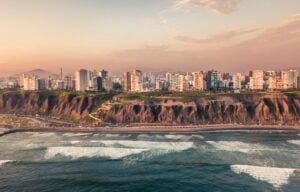
Geographically the pocket sits on the northwest edge of San Isidro, where the district meets Magdalena del Mar. Locals navigate it by three avenues: Avenida Pezet on the coastal side, Avenida Salaverry as the spine running east, and Avenida Del Ejercito marking the transition into Magdalena. Inside that polygon you will hear streets like Jorge Basadre Grohmann, Las Flores, Schell (the San Isidro stretch), Godofredo Garcia and Pezet itself. The block matters more than the address; at this height of the district you still find late republican mansions, official diplomatic residences, and quiet six-to-eight-floor boutique buildings sharing the same sidewalk.
The contrast with neighbors matters. Country Club / El Golf is the most expensive and most visible micro-pocket, anchored to the Lima Golf Club. El Olivar wraps around the historic olive grove, declared a National Monument in 1959. Chacarilla del Estanque (the San Isidro side) is the family-oriented edge of the district. Orrantia del Mar is none of those: no golf views, no olive grove, no border with Surco. It is the quiet pocket where diplomats live and where actual houses with gardens still trade hands.
The embassy row factor
The fastest way to explain Orrantia del Mar to someone arriving from DC, London or Madrid is to show them the embassy map. San Isidro hosts the bulk of diplomatic missions accredited to Peru, and several chanceries and ambassadorial residences sit either inside the Orrantia polygon or right on its border.
From publicly verifiable sources: the Argentine Embassy chancery has historically been associated with the Orrantia del Mar area, with an address referenced at Av. Jorge Basadre Grohmann 1470. The Embassy of Honduras for Peru and Bolivia is listed at Calle Godofredo Garcia 480, Orrantia del Mar. The Embassy of India sits at Av. Salaverry 3006; Switzerland at Av. Salaverry 3240; the Russian Federation at Av. Salaverry 3424. All of these fall inside the immediate Orrantia perimeter.
One detail that often confuses incoming foreign buyers: many missions split chancery (the office) from official residence (the ambassador’s home), each at a different address. The British Embassy is a useful example: its chancery operates from the Torre Parque Mar at Av. Jose Larco 1301 in Miraflores, while the residence may be elsewhere. The Brazilian Embassy keeps its chancery at Av. Jose Pardo 850 in Miraflores. Bottom line: never assume; always verify each mission via its own website or the Peruvian Ministry of Foreign Affairs directory.
For the residential buyer, the practical effect is meaningful. Diplomatic presence translates into permanent municipal patrolling, coordinated private security booths, San Isidro municipal cameras, and an unwritten traffic discipline that keeps the area calm even at peak hours. You inherit, at no extra cost, the security infrastructure that the State and foreign missions have already deployed around your block.
Housing stock: large homes, low-rise boutique buildings
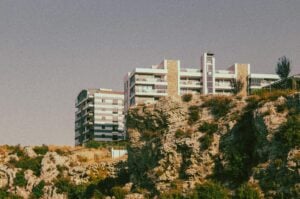
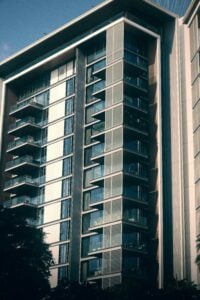
Orrantia del Mar’s housing supply looks different from the rest of San Isidro. While Centro Financiero and parts of El Olivar consolidated as 12-to-20-floor towers, here the rule (written and unwritten) has been low-rise. Walk the streets and you see six-to-eight-floor buildings, boutique compounds with few units per floor and, above all, houses. Real houses: 400 to 800 sqm lots, two stories, basement storage, double garage, rear garden.
That typology fits the historic buyer profile: large families, ambassadors, expatriate executives on multi-year assignments, and local buyers coming from elsewhere in Lima looking for a lot size that no longer exists in Miraflores or Surco. A family moving from a 220-sqm Miraflores apartment can step into a 500-sqm house without leaving the San Isidro logistics: hospitals 10 minutes away, private schools five, the financial district twelve.
The last five years brought something new: silent conversion. Some large homes have sold to boutique developers who tear them down to build small low-rise condominiums, respecting the municipality’s low-density parameters. The product is a 250-to-400-sqm apartment with three or four bedrooms, minimal common amenities, and a price tag that competes with Country Club penthouses. No marketing towers, no overdone gym-and-pool packages; the pitch is location, low density, and the guarantee of looking at trees from your living room. Buyers researching this format usually cross-read our guide on buying luxury real estate in Lima from abroad: verifiable neighborhood beats generic tower.
Prices, ticket sizes and how it compares
Anchor number first: per the Urbania Index released at the end of 2025 and reported by La Republica, San Isidro leads Lima at S/ 9,231 per square meter (roughly US$ 2,460/sqm). The same report splits the district into two zones because the gap inside it exceeds 15%, with the El Golf zone averaging S/ 12,097/sqm — the highest in the city. For Lima Metropolitana overall, the figure stands at S/ 6,806/sqm at year-end 2025, with a real decline of 0.4% over the year.
For Orrantia del Mar specifically, no public sub-neighborhood index exists yet. Active listings show a wide spread: smaller, older apartments can list near US$ 1,800 to US$ 2,200 per sqm, while new low-rise boutique product asks US$ 2,500 to US$ 3,200 per sqm. Houses are priced more by lot and address than by construction itself: a 600-sqm lot on a quiet inner street easily clears US$ 1.5M, and the buyers looking at it are running two parallel calculations — one for the home, one for the redevelopment potential within municipal parameters.
The comparison that helps US-Hispanic readers: think of Country Club / El Golf as Lima’s Coral Gables — manicured, branded, with the highest per-sqm price in town. Orrantia del Mar is closer to a quiet Aventura side street: same micro-region, same ZIP-code prestige, but more square meters per dollar and less marketing visibility. The unit ticket can converge — both pockets clear US$ 1.2M without difficulty — yet average per-sqm in Country Club tends to run 10% to 20% above Orrantia. Same budget buys you more meters in Orrantia and more view in Country Club.
Daily life: parks, schools, services
Living in Orrantia del Mar is not isolated living, even though the pocket itself is not a commercial hub. The math works because everything San Isidro offers is six to twelve minutes away by car. The Bosque El Olivar — 1,946 trees on 10 hectares, declared a National Monument on December 16, 1959 and a Conservation Area in 2017 by the San Isidro Municipality — is right next door. A Sunday walk through the olive grove is one of the differences between living in San Isidro and living anywhere else in Lima.
School coverage is dense and a major reason diplomats settle here. Within the district and immediate neighbors you find Markham College (the British curriculum benchmark, often described as Lima’s Eton or Andover), Pestalozzi (Swiss curriculum), Colegio Aleyán (German tradition), Carmelitas, and San Silvestre. The mix of British, Swiss, German, and Peruvian-international tracks explains a sizeable share of the diplomatic demand. A family moving in for a three-to-four-year posting needs a verifiable international school and short commute. Orrantia delivers both.
Daily commerce is solved outside the polygon. Wong and Vivanda supermarkets, reference bakeries (La Baguette, San Antonio), specialty coffee, and the restaurants of Avenida Pardo y Aliaga are five to ten minutes away. The pocket is purely residential, fed by the rest of the district’s commerce. Life here feels closer to a well-connected European inner suburb than to the saturated Lima outsiders imagine.
Who actually buys in Orrantia del Mar
Three buyer profiles repeat. The first is the diplomatic and corporate expatriate: a mining, banking or pharma executive on a three-to-five-year contract who rents in a safe pocket near the international school. They may not buy, but they sustain a rental market that keeps prices firm and gives liquidity to actual owners.
The second is the third-generation Peruvian family office. Main home elsewhere — Country Club, Casuarinas, La Planicie — but they hold a property in Orrantia as a second urban residence, a home-office, or housing for adult children. The logic is patrimonial more than transactional: buy well, hold, only sell when there is a real reason.
The third is the returning Peruvian. A professional who lived 15 to 25 years abroad — Miami, Houston, Madrid, Buenos Aires, New York — and is moving back in their late forties or early fifties. They know the area because their family or friends grew up there; they want to come back to that specific Lima, not the Lima of the new towers. This profile asks the most about Orrantia del Mar San Isidro when they walk into a broker’s office. If you fit this description, our companion piece on buying Lima luxury real estate from abroad covers the legal, tax, and FX steps to actually close.
Frictions and what to verify before you sign
Orrantia del Mar is not friction-free. The first issue is supply. Because there are few towers and many houses, listed inventory tends to move slowly and sometimes off-market. A house can come on the market without advertising, pass through two or three known buyers in the broker’s network, and close before it ever appears on a portal. If you are arriving from outside Peru, you need a broker with actual relationships inside the pocket, not one that just shows you what is uploaded online.
The second is regulatory. Current San Isidro zoning prioritizes low density in residential pockets like Orrantia, which is good for the neighbor but caps developer upside. Before paying a premium for a house assuming redevelopment, ask the broker for the current Certificado de Parametros Urbanisticos y Edificatorios (zoning certificate) issued by the San Isidro Municipality and have a local architect validate the lot’s actual buildable factor.
The third is title. Some properties carry complex registry history: divisions, inheritances with foreign beneficiaries, multiple generations of ownership. Verifying the SUNARP record, the municipal cadastral status, any liens or charges, and the property tax position is upfront work, not after-the-fact. The fourth is market: even the premium pockets adjust. The 0.4% real decline in Lima’s per-sqm price during 2025 (Urbania Index) is a reminder that buying well still beats buying expensive.
Quick facts on Orrantia del Mar
- District: San Isidro, Lima.
- Origin: Subdivision authorized in 1924, integrated into San Isidro in 1931 (Decree Law 7113).
- Reference boundaries: Av. Pezet, Av. Salaverry, Av. Del Ejercito, Magdalena del Mar border.
- Profile: large houses, low-rise boutique buildings, diplomatic presence.
- District per-sqm: S/ 9,231 average for San Isidro at year-end 2025 (Urbania Index, via La Republica).
- Comparison: Country Club / El Golf reaches S/ 12,097/sqm in the southern zone.
- Nearby landmark: Bosque El Olivar, National Monument since 1959.
Frequently asked questions
A final note, not a recap
Orrantia del Mar San Isidro works because it does something almost no other Lima Top pocket still pulls off: it combines low density, a verifiable diplomatic neighborhood, and residential stock with real history. It is not the flashiest micro-pocket; it is the one you choose after you have understood the district, ruled out the generic tower, and decided you want a neighborhood that actually feels like one. If you are weighing a serious move into San Isidro, this pocket deserves a walk-through before you sign anything.
Rates, prices and figures cited correspond to April-May 2026 and are subject to change. Penthouse.pe is neither a financial advisor nor a bank; before making investment decisions, consult your trusted advisor and a financial institution regulated by Peru’s SBS. Embassy and diplomatic residence addresses are cited from official and public sources available at the time of writing; always verify the current address through the relevant mission’s official website or the Peruvian Ministry of Foreign Affairs directory before any official action.
Considering a property in Orrantia del Mar or any other San Isidro pocket? Email us at hola@penthouse.pe and we will walk you through inventory we know directly — house by house, building by building.