Most international buyers looking at Chacarilla on Lima maps mix up two neighborhoods that share a name and almost nothing else. The northern half sits in San Isidro and serves the financial district. The southern half, the one this article covers, sits in Santiago de Surco and runs along Avenida Primavera down to Caminos del Inca. It is Lima’s most consolidated family-luxury enclave: home to Markham College’s expanded campus, anchored by the El Polo retail corridor, and built almost entirely on low-density boutique buildings rather than vertical towers. If you are buying from Miami, Madrid, or Houston, this is the barrio you would compare to Coral Gables before comparing it to Brickell.
- Surco vs San Isidro: why the line on the map matters
- The buyer profile: established families with consolidated wealth
- The Markham effect on the residential market
- The El Polo corridor: retail, offices, and neighborhood canteen
- Boutique low-density buildings: the dominant format
- Concrete numbers: what buying actually costs in 2026
- How to choose between Chacarilla Surco and the alternatives
- What to verify before visiting the neighborhood
- Comparing Chacarilla Surco with Coral Gables and Brickell familiar Miami
- Frequently asked questions
Surco vs San Isidro: why the line on the map matters
Chacarilla del Estanque, as registered with Lima’s cadastre, straddles three districts: Santiago de Surco holds the largest portion, San Borja holds the eastern flank, and the commercial use of “Chacarilla” extended decades ago into the southern edge of San Isidro. For an international buyer, the distinction is not academic. It changes the price per square meter, the daily commercial ecosystem, and the municipality you pay taxes to.
On the Surco side, average prices for two-bedroom apartments hovered near S/ 7,745 per square meter at year-end 2024 according to Urbania data, while neighboring San Isidro Sur reached S/ 12,097 per square meter for premium zones like El Golf [TO BE VERIFIED: Urbania Index Q1 2026 specific Surco-side figure]. Translated to USD at roughly S/ 3.75 = US$ 1, the Surco side comes in around US$ 2,065 per sqm versus US$ 3,225 per sqm on the San Isidro side. That spread buys you about 50% more square meters on the Surco side for the same dollar ticket.
The commercial backbone is also different. Surco’s Chacarilla relies on the Avenida El Polo retail corridor and Caminos del Inca for daily errands, gym, brunch, and offices. San Isidro’s Chacarilla relies on Camino Real and the Aldebaran cluster. They do not feed each other; they are parallel ecosystems that happen to share a name.
Finally, you pay Surco taxes. The Santiago de Surco municipality runs your trash collection, your serenazgo security patrols, and your urban controls. San Isidro and Surco have different tax bases and different service models. For a family with children at Markham or Magister, the daily lived experience of the Surco municipality is what defines the neighborhood, not the postal code.
The buyer profile: established families with consolidated wealth
Chacarilla Surco’s typical buyer is not a young couple looking for a walkable cliff-side apartment. The profile here is the consolidated family: parents between 38 and 55, two to four children, two cars, often a large dog, with combined household incomes that support tickets between US$ 600,000 and US$ 1.8 million. Their priorities, in order, are school logistics, green space for the kids, and parking security.
Markham College’s expansion to its new Monterrico campus -reported by Infobae in November 2023 with two pools, theater facilities, and three football pitches- triggered a meaningful migration of families from San Antonio Miraflores and Aurora to the Chacarilla-Monterrico cluster. When a school that consistently appears among Peru’s most expensive announces a complete relocation, the residential market reorganizes around it. Most buyer agents in the area saw the migration accelerate from late 2023 onward.
The second buyer cohort is more interesting for resale dynamics: the established Surco family that originally bought a house with a garden in the late 1980s or 1990s. Their plot is between 400 and 800 square meters, and they are now empty-nesters. They sell the house and move to a boutique apartment within the same neighborhood. They do not want to switch barrios, they want to downsize without losing their reference points.
The third buyer is the returning Peruvian. Someone who lived in Miami, Madrid, or Houston for fifteen or twenty years, comes back with pre-teen children, and needs a hard bilingual school plus a walkable barrio. For this buyer, Chacarilla Surco competes directly with Coral Gables in Miami: similar demographic, similar density, similar emphasis on family infrastructure rather than nightlife.
The Markham effect on the residential market
Markham College’s footprint matters here because school logistics drive housing decisions in a way that overrides almost every other variable for families with school-age children. Markham’s Early Years and Primary section operates at Avenida La Republica 111 in the El Derby urbanization, minutes from Chacarilla. The Secondary campus historically operated at Augusto Angulo in San Antonio, Miraflores, and the recent investment in the new Monterrico campus consolidated the school’s presence within the Surco quadrant.
Magister, another anchor school, sits on Calle Francisco de Cuellar 686 in Monterrico. Its trilingual program (Spanish, English, French) and IB certification make it a peer reference for international families. The school cluster -Markham (El Derby and Monterrico), Magister (Monterrico), Casuarinas (Las Casuarinas)- creates a quadrant where a Chacarilla-resident parent can keep daily school commute under fifteen minutes. That implicit subsidy in time and chauffeur hours never shows up in Urbania reports, but it weighs heavily in purchase decisions.
There is a temporal element worth noting. When a top school announces a full relocation, families with kindergarten and first-grade children migrate first because the time savings compound over the next ten to twelve years. Families with children in late high school typically do not move because the emotional cost of switching schools outweighs the logistical savings. So the buying pressure on Chacarilla Surco comes mostly from young-to-mid families, not from late-stage families. If you are a buyer’s agent reading this, that cohort is your highest conversion target.
The El Polo corridor: retail, offices, and neighborhood canteen
Centro Comercial El Polo opened its first phase in 1996. According to Binswanger’s analysis of the area, today it concentrates over 150 stores, multiple restaurants, gyms, a health center, and a business center along the same axis. Avenida El Polo stopped being a transit road more than a decade ago and became the reference commercial corridor for Chacarilla, Monterrico, and Las Casuarinas.
For a Chacarilla Surco resident family, El Polo functions as multiple things at once. It is the neighborhood supermarket: Wong and Vivanda in walkable formats. It is the food court: chains and full-menu restaurants with terraces. It is the office cluster: El Polo II and El Polo Plaza Center now host law firms, family offices, and boutique financial advisories that migrated from San Isidro Centro Financiero looking for parking, reasonable lease costs, and proximity to their actual clients. It is the gym, the salon, the Saturday-morning cafe.
The architectural advantage of El Polo is that it does not compete with Real Plaza or Jockey Plaza on scale. The three malls along the axis -CC El Polo, El Polo Plaza Center, and Urban Plaza- function as differentiated anchors. CC El Polo handles food and services. El Polo Plaza Center handles offices and terrace dining. Urban Plaza, the youngest, picked up brands that no longer fit at Jockey. For a premium buyer, the fragmentation is a feature: park once, walk, consume, return. The feel is neighborhood, not megamall.
Boutique low-density buildings: the dominant format
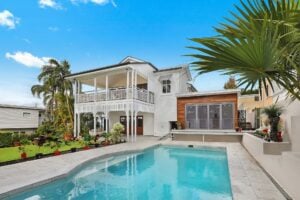
When a broker shows you Chacarilla Surco, expect to see four-to-six-story buildings with two to four apartments per floor. No towers. The residential zoning and height regulations favor low-rise developments, and boutique developers leverage that framework to build small unit counts with large apartments -150 to 300 square meters- instead of compact units in vertical towers.
Three formats dominate. First, eight-to-twelve-unit buildings with two apartments per floor. Each owner gets a full floor with double-frontage views. Apartments range from 200 to 280 square meters, three to four bedrooms, separate laundry, service room with full bath, terraces of 30 to 60 square meters. This is the format that the empty-nester family buys after selling the house.
Second, low-rise duplexes. Two to three levels, with the ground floor as a flat and the upper levels as duplexes with private gardens or roof terraces. Families with toddlers and dogs gravitate toward this format because it offers garden access without sharing.
Third, small condominiums. Three or four houses inside a single gated lot, sharing the entrance and sometimes a pool, each house with its own garden. This is the premium-premium format of Chacarilla Surco. Houses of 350 to 500 sqm on lots of 250 to 400 sqm, ticket above US$ 1.5 million [TO BE VERIFIED: average condominium ticket Chacarilla Surco 2026].
What you will almost never see are buildings above ten floors. Zoning prohibits them and, more importantly, the existing community of owners pushes back against any project that breaks scale. That resistance is part of the neighborhood’s value: nobody wants their building blocked by a new tower.
Concrete numbers: what buying actually costs in 2026
The Urbania reports that circulate among brokers placed the average two-bedroom price per square meter in Chacarilla del Estanque, Surco side, near S/ 7,745 at year-end 2024. For 2026, most market actors project annual growth between 3% and 6% in Lima Top luxury segments [TO BE VERIFIED: exact 2026 growth range Urbania for Surco Chacarilla]. That puts the average per square meter close to S/ 8,000 to S/ 8,300 in 2026, or roughly US$ 2,130 to US$ 2,210 per sqm.
Real-world tickets follow. A boutique 180 sqm apartment in Chacarilla Surco -three bedrooms, two parking spots, two storage units, in an eight-to-twelve-unit building- sits today between US$ 480,000 and US$ 700,000 depending on finishes, year built, and floor [TO BE VERIFIED: exact comparable ranges H2 2026]. Move up to 220 sqm with three bedrooms plus a study in a new building, and the range becomes US$ 700,000 to US$ 950,000. A 320 sqm duplex with private rooftop and pool sits between US$ 1.1 million and US$ 1.8 million.
A house in a gated condominium, with a 250-to-350 sqm lot and 350-to-450 sqm of construction, ranges between US$ 1.4 million and US$ 2.3 million. Standalone houses without a condominium structure run from US$ 900,000 to US$ 1.8 million for 1980s and 1990s constructions in original condition; the same house with a complete renovation moves into the US$ 1.5 million to US$ 2.5 million range.
Mortgage rates as of April 2026, per public SBS data, sit approximately between 7.8% and 9.2% in soles for traditional mortgages [TO BE VERIFIED: exact SBS April 2026 average]. USD rates for premium-profile borrowers range between 6.2% and 7.4%. The spread between soles and dollars has compressed compared to prior years, which changes the currency decision. A buyer earning in USD -typical of the returning Peruvian or the expat- usually prefers a USD mortgage; a buyer earning in soles takes soles.
For an international buyer, two practical complications deserve attention. First, currency conversion costs. Moving funds from a US, EU, or Latin American account into Peru typically routes through SWIFT correspondent banks and incurs spread plus fees of 0.4% to 1.0% depending on the corridor. For a US$ 1 million purchase, that is between US$ 4,000 and US$ 10,000 in friction. Some private banking corridors compress this further. Second, escrow and notary timing. Peruvian property closings happen at a notary, not at a title company, and the timing between signing minuta, paying Alcabala (3% above 10 UIT), registering with SUNARP, and getting clean title runs about 30 to 60 days for a clean transaction. Plan accordingly if you are buying remotely; do not plan a single-week trip to Lima expecting to close on day five [TO BE VERIFIED: average closing timeline 2026 reference].
How to choose between Chacarilla Surco and the alternatives
If you are weighing Chacarilla Surco against San Antonio Miraflores or Country Club San Isidro, the decision moves along five vectors. Look at them together rather than one by one.
School vector. If your children attend Markham, Magister, or Casuarinas, Chacarilla Surco wins outright. If they attend Newton, Hiram Bingham, or Carmelitas, Surco competes more weakly against La Molina and Miraflores. If they attend Roosevelt, La Molina wins directly.
Walkability vector. San Antonio Miraflores and Country Club San Isidro win on boardwalks and parks (Olivar, Malecon Cisneros). Chacarilla Surco trades that for in-neighborhood security: wide sidewalks, tree-lined streets, low through-traffic. You can walk a dog at night without thinking.
Investment and resale vector. Country Club leads in historical price-per-meter appreciation. Chacarilla Surco is the consolidated second tier with lower volatility: buyers who buy in Chacarilla Surco tend to sell in Chacarilla Surco. That makes prices more stable than in San Antonio Miraflores, where buyers can migrate to Barranco or to Country Club.
Adult lifestyle vector. If your social life centers on the Centro Financiero, Conquistadores restaurants, Aldebaran gym, and diplomat neighbors, San Isidro Sur wins. If your social life is brunch at El Polo, weekend matches at La Planicie, and a country house near Chosica, Surco wins.
Time horizon vector. If you are in Lima for two to five years -typical for mining executives, embassy staff, multinational rotations- Country Club or Centro Financiero usually win on office proximity and Roosevelt school logistics. If you are staying ten years or for good, Chacarilla Surco competes better: stability, space, and family projection.
What to verify before visiting the neighborhood
If you are doing a first reconnaissance, structure it. Start at Avenida El Polo at the height of Caminos del Inca, follow the corridor through the three malls, then enter Calle Velasco Astete or Calle Las Camelias. You will see the premium retail first, then the residential heart, then the gated condominiums.
Visit on a Saturday morning and a Tuesday afternoon. Saturday morning shows the family mode: runners, dogs, kids on bicycles, parents at cafes. Tuesday afternoon at five shows the school mode: pickup runs, school buses, controlled traffic. Both moments tell different stories and both matter for your decision.
Always ask about parking ratio per apartment. The Chacarilla Surco target family typically has at least two vehicles, often three, and a building that offers only one parking spot per apartment will limit your buyer pool when you eventually resell. Ask about storage units too: a good Chacarilla Surco storage unit adds US$ 8,000 to US$ 15,000 to the purchase price and trades as a separate item.
Ask about the structural year of construction and the year of electrical and plumbing renovations. Chacarilla Surco has buildings from the 1980s with attractive structure but electrical systems that need intervention. Ask about seismic certification: Peruvian standards require seismic certification since 2003, and earlier buildings should have post-construction structural evaluation. Not optional.
Finally, ask about the building’s internal regulations and the owners’ association dynamic. In small boutique buildings the way the board operates conditions quality of life significantly. A functional, reasonable board is an asset that never appears in any Urbania report but you feel from the first month.
Comparing Chacarilla Surco with Coral Gables and Brickell familiar Miami
For US-based Hispanic buyers and returning Peruvians coming from Miami, the most useful mental model is to triangulate Chacarilla Surco against Coral Gables, Pinecrest, and Brickell familiar. The comparison is imperfect, but it works for buyer-profile alignment.
Coral Gables shares the most DNA with Chacarilla Surco. Both are mid-rise neighborhoods built around schools (Coral Gables has Gulliver and Carrollton; Chacarilla has Markham and Magister). Both prioritize tree-lined streets, low-density boutique buildings, and a walkable retail corridor (Miracle Mile vs El Polo). Both have a stable buyer base of established families that buy and hold rather than flip. Pricing differs in absolute terms -Coral Gables single-family homes routinely cross US$ 3 million- but the family-luxury logic transfers cleanly. A Coral Gables family that decides to relocate to Lima will feel at home in Chacarilla Surco within a week.
Pinecrest is the closest equivalent for the standalone-house buyer in Chacarilla Surco. Larger lots, more emphasis on private gardens, higher chauffeur dependence, weaker walkability than Coral Gables but stronger family infrastructure. The Chacarilla Surco condominium format -three or four houses inside a gated lot- is closer to a private street in Pinecrest than to a Coral Gables block.
Brickell familiar -the residential pocket of Brickell rather than the office tower core- is what Chacarilla Surco is not. Brickell familiar is dense, vertical, amenity-heavy: rooftop pools, concierge, gym, full-service buildings with 200 to 600 units. Chacarilla Surco rejects that format. The buyer who wants a Brickell-style tower experience in Lima looks at El Golf in San Isidro Sur, or at certain new towers along Malecon Cisneros in Miraflores. Not Chacarilla Surco.
If your buyer comes from Miami and asks “what is the Lima version of where I live now?”, the answer hinges on this triangulation. Coral Gables maps to Chacarilla Surco apartment buyer. Pinecrest maps to Chacarilla Surco house buyer. Brickell maps to El Golf or to certain Miraflores towers, not to Chacarilla Surco. Getting this right at the first call shortens the search by months.
For broader market context, see our Lima Top price-per-sqm 2026 guide, the Miraflores deep-dive, and the San Isidro overview. International buyers should review buying luxury apartments from abroad. Tax references: Alcabala tax, SUNARP search, purchase agreements. External authoritative sources: Urbania neighborhood profile, Infobae on Markham, Binswanger on El Polo.
Frequently asked questions
Chacarilla del Estanque on the Surco side is not a fashionable neighborhood. It is a consolidated one, with families that have lived there across two and three generations, an ecosystem of services built over thirty years, and a buyer profile that prioritizes stability over novelty. That maturity shows in pricing, in liquidity, and in low building turnover. If you are looking for a property that appreciates steadily without scares, where your kids have schools nearby and your adult life has the El Polo corridor at hand, this is one of the few Lima neighborhoods that delivers both at once.
Rates, prices and figures referenced correspond to May 2026 and are subject to change. Penthouse.pe is neither a financial advisor nor a bank; before making investment decisions, consult your trusted advisor and the financial institution, which must be regulated by Peru’s SBS.
If you want to see current Chacarilla Surco opportunities with verifiable data and no sales pitch, write to hola@penthouse.pe and we will connect you with neighborhood-specific coverage.