Digital Nomads and Remote Buyers: The Lima Penthouse as a Second Home
Lisbon got expensive, Mexico City got crowded and Medellin is no longer a secret. Meanwhile, Lima keeps flying under the radar — which, if you are a serious-budget digital nomad scouting a second home, is great news. Direct flights to Miami in six hours, residential fiber averaging 235 Mbps, the world’s number-one restaurant (Maido) and a square meter in San Isidro hovering near USD 2,500 versus the USD 7,000 you would pay in central Lisbon. If you are evaluating where a digital nomad can buy an apartment in Lima as a second home, this is the right moment to look closely.
Table of contents
- Why Lima now: the secret tier of post-pandemic nomad hubs
- Connectivity, fiber and direct flights
- Rentista visa and migratory options
- Neighborhoods for nomads: Barranco, Miraflores and San Isidro
- The penthouse as a second home: layout and home office
- Cost of living: Lima vs Lisbon, CDMX and Medellin
- Quick facts to decide
- Frequently asked questions
Why Lima now: the secret tier of post-pandemic nomad hubs
The pandemic did two things to the Latin American digital nomad map. First, it normalized remote work across time zones. Second, it inflated the well-known hubs: Lisbon shifted from cheap to one of Western Europe’s pricier capitals, Mexico City pushed Roma-Condesa rents past Brooklyn levels and Medellin lost some of its charm as El Poblado saturated. Lima enters this board as the destination almost nobody on the LinkedIn nomad circuit mentions yet, but which checks the six hard requirements of a well-funded remote worker: USA Eastern time zone overlap, direct flights, symmetric fiber, world-class food, reasonable cost and a real estate market where a penthouse with a Pacific view still trades at numbers unthinkable in other capitals.
For a digital nomad looking to buy an apartment in Lima, the move stopped being an exotic bet. It is a portfolio decision today. And for the remote buyer who already keeps a base in Miami, Madrid or Bogota, adding a Lima second home solves two problems at once: real estate diversification and a real landing pad for the three months a year you want to eat at Maido and Central without feeling stuck in an Airbnb. If you are coming in from abroad, start with our guide on buying a luxury Lima apartment from overseas, where we walk through the full legal and banking flow.
Connectivity, fiber and direct flights
The first filter for any digital nomad is internet. Lima delivers without excuses. Recent Speedtest Ookla figures show Peru’s average fixed broadband hit 143.67 Mbps download and 140.23 Mbps upload by early 2025, with fiber accounting for 81% of all fixed connections. In Lima Top districts (San Isidro, Miraflores, Barranco, San Borja, La Molina) Movistar Fibra residential plans average 235.4 Mbps and premium tiers reach symmetric gigabit. That is more than enough for 4K video calls, remote editing or any distributed-team workload.
The second filter is flights. Lima sits at UTC−5 year-round, identical to New York during standard time and one hour behind during daylight saving. Your 9 a.m. standup in Manhattan stays your 9 a.m. standup in Miraflores. Air connectivity backs this up: American operates 21 weekly nonstops Lima–Miami, LATAM runs 18 weekly frequencies on the same route, Delta handles around 8 nonstops a week and JetBlue connects with JFK. Toward Europe, Iberia offers 14 weekly nonstops to Madrid, LATAM 7 and Air Europa another 7. For a European who wants bases on both sides of the Atlantic, Lima works as a natural hub.
Rentista visa and migratory options
Peru does not yet have a formal Digital Nomad Visa like Portugal or Spain, but it does have the Rentista migratory status, regulated by Legislative Decree 1350 (Migrations Law) and its regulations. Rentista lets you reside in Peru if you can prove permanent income from abroad of at least USD 1,000 per month, plus USD 500 per additional dependent, with funds entering Peru through a banking institution. For a digital nomad with investment income, pension, royalties or dividends, this is the natural path. Residency renews annually and the procedure is handled through the Migrations Digital Agency.
If your income comes from remote work invoiced to a foreign company, you can also enter as a tourist (up to 183 days per calendar year for citizens of most Western countries) and, in parallel, scale up to Rentista or to permanent residency. Regulatory news to watch: Law 32421, enacted in August 2025, tightened some solvency and formalization requirements for permanent residency. Before starting any process, confirm the current detail at Peru’s official Migrations site or with a Lima-based immigration attorney. [TO BE VERIFIED: exact solvency thresholds under Law 32421 as of late 2026].
Neighborhoods for nomads: Barranco, Miraflores and San Isidro
Lima is not one city. It is a mosaic of districts, each with its own personality, and three of them concentrate the penthouse supply for the remote buyer: Barranco, Miraflores and San Isidro. Each fits a different profile.
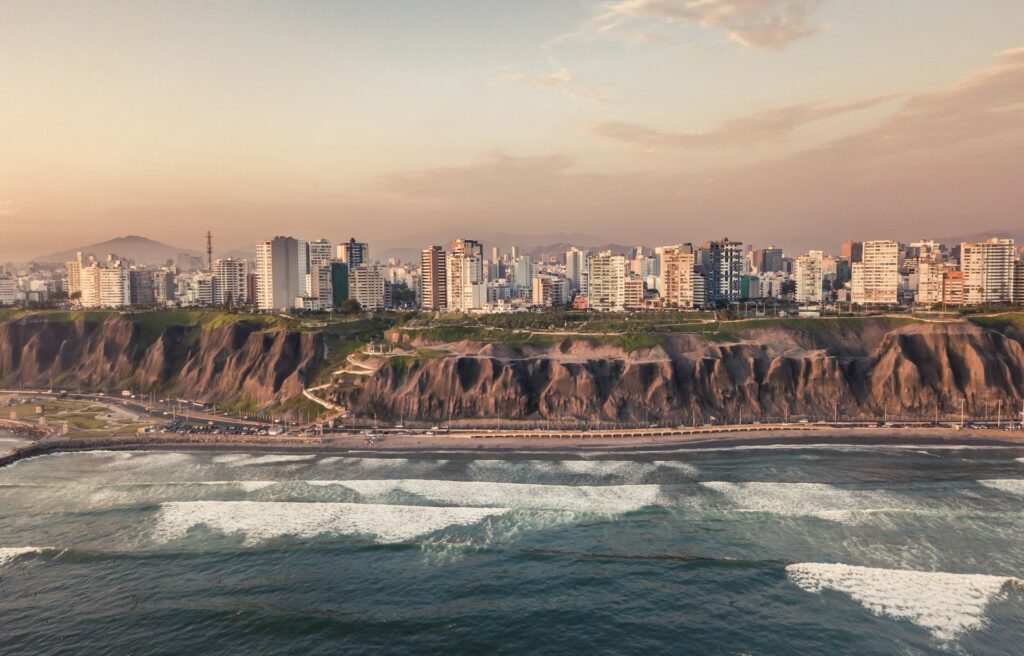
Barranco is the bohemian, creative district. Murals, galleries, specialty coffee, bars open until 2 a.m. and the strongest young chef scene in town. This is where the nomad coming from Brooklyn, Williamsburg or Lisbon’s Lapa feels at home. The malecón offers the prettiest sunset on the Pacific and the district keeps an old-town texture that Miraflores has lost. Price-wise, Barranco has consolidated as one of Lima’s most expensive districts: average price per square meter sits near S/9,169 (around USD 2,450 at May 2026 exchange rates), per recent Urbania data.
Miraflores is the cosmopolitan district. It packs almost everything: the Pacific malecón, Kennedy Park, LarcoMar, the densest cluster of top restaurants and the city’s largest coworking network. It is the neighborhood where the freshly arrived digital nomad feels at home fastest because everything sits inside six blocks. Average price per square meter hovers around S/8,831. If the area is new to you, our piece on 14 reasons to live in Miraflores covers the district detail.
San Isidro is the corporate, premium-residential district. Home to banks, consultancies and embassies, with the Lima Golf as a green lung and the country’s main financial corridor. This is where remote buyers focused on security, premium services and quick airport access via the expressway tend to land. By April 2026 San Isidro consolidated as the capital’s most expensive district at S/9,268 per square meter, surpassing Barranco. The San Isidro Sur sub-area reaches S/11,947 per square meter. For more on the area, see our 9 reasons to live in San Isidro.
The penthouse as a second home: layout and home office
For a remote buyer, a penthouse is not just square meters with a view. It is a functional decision. If you plan to live three to six months a year in Lima and rent the unit the rest of the time, the layout has to work both for your personal routine and for medium-term corporate leasing. What we recommend to digital nomad clients hunting penthouses in Lima Top:
- Independent home office, ideally facing an inner street or terrace, with a dedicated fiber drop and a stabilized power line.
- West-facing terrace to catch sunset over the Pacific (especially in Miraflores and Barranco facing the malecón).
- Open kitchen with island built for heavy use (you will cook more than you think, even with Maido fifteen minutes away).
- Master bedroom en suite with walk-in closet, leaving the other two bedrooms free for guests or corporate rental.
- Building amenities: gym, sauna, in-house coworking lounge, rooftop grill and at least two parking spots.
- Backup generator and 24-hour water reserve, non-negotiable in any premium Lima building.
The typical Lima Top penthouse that meets all of the above runs between 180 and 280 m² indoor area, plus 40 to 100 m² of terrace. Gross pricing lands between USD 550,000 and USD 1,300,000 depending on zone, building age and finish level. Coming from Manhattan, Miami Beach, Madrid or Lisbon, those numbers will read as a structural discount for very comparable quality of life. Once you move toward closing, get familiar with the Peruvian purchase contract, which has its own quirks compared with the Anglo-Saxon model.
Cost of living: Lima vs Lisbon, CDMX and Medellin
This is where Lima shines for the remote buyer. Using the most recent Numbeo indices (May 2026) and normalizing to a digital-nomad basket — two-bedroom apartment in a top zone, gym, transport and dining out twice a week — the ranges land like this:
| City | 2BR rent, top zone | Monthly nomad cost | Buy price per m², top zone |
|---|---|---|---|
| Lisbon (Chiado/Principe Real) | USD 2,100–2,800 | USD 3,200–3,800 | USD 6,500–7,500 |
| Mexico City (Roma/Condesa/Polanco) | USD 1,400–2,200 | USD 2,400–3,000 | USD 4,000–5,500 |
| Medellin (El Poblado/Laureles) | USD 900–1,500 | USD 1,800–2,300 | USD 2,300–3,000 |
| Lima (Miraflores/Barranco/San Isidro) | USD 1,100–1,700 | USD 2,000–2,600 | USD 2,400–3,200 |
Lima sits slightly above Medellin but clearly below Lisbon and CDMX, with the added bonus of the strongest food scene in the region. On the 2025 Latin America’s 50 Best Restaurants list, Lima contributes Maido (no. 1 in Latin America and worldwide), Kjolle (no. 9 and Best Restaurant in Peru), Merito (26) and Mayta (39). Four restaurants in the top 40 of the continent. That culinary density is hard to find in Lisbon or Medellin, and CDMX competes but at a higher cost of living.
If the tax angle matters to you, review our notes on buying from abroad and talk to a local accountant before closing.
Quick facts to decide
- Time zone: UTC−5 year-round (no daylight saving). Same as New York during winter.
- Average internet, Lima Top: 235 Mbps on premium residential Movistar Fibra plans; symmetric gigabit available.
- Key direct flights: Miami (American, LATAM, Delta), JFK (JetBlue, LATAM), LAX (LATAM), Madrid (Iberia, LATAM, Air Europa).
- Rentista visa: USD 1,000/month minimum + USD 500 per dependent; renews annually.
- Lima entries on 2025 Latin America’s 50 Best: Maido (1), Kjolle (9), Merito (26), Mayta (39).
- Average price per m², Lima Top: San Isidro S/9,268, Barranco S/9,169, Miraflores S/8,831 (Urbania, April 2026).
Frequently asked questions
Can I buy a Lima penthouse without being a Peruvian resident?
Yes. Peru allows foreigners to buy urban real estate without prior residency, except in border zones (within 50 km of the border). You only need a valid passport, optional RUC tax ID to report the operation and a Peruvian bank account. The deal is formalized before a notary. Full detail in our guide for foreign buyers.
Does the Rentista visa work if I do remote work for a US company?
Rentista is designed for passive income recipients (pensions, dividends, rentals, royalties). If your income comes from payroll or invoices to a foreign company, the right migratory status may differ. Get advice from an immigration attorney before applying; rules were updated by Law 32421 in 2025.
What is the best Lima area for a first-time digital nomad?
Miraflores. Restaurants, coworking, gyms, the ocean, retail and transport sit within walking distance, and it is the district where you orient yourself fastest if you do not speak Spanish yet. Once settled, you can move to Barranco for the creative scene or to San Isidro for quieter, corporate surroundings.
How much should I budget to live well as a nomad in Lima?
USD 2,000 to USD 2,600 a month covers a two-bedroom apartment in Miraflores or Barranco, gym, transport (mix of Uber and walking), groceries and dining out two to three times per week, including top-50 restaurants. With a leaner standard you can live comfortably on USD 1,500.
Can I rent the penthouse out when I am not in Lima?
Yes, and it is a common strategy. Medium-term corporate leases (3 to 12 months) to expat executives or mining executives based in Lima can generate USD 2,500 to USD 5,000 per month in top zones. Vacation rentals via platforms also work, but watch the municipal regulation, which keeps tightening.
How does Lima compare with Lisbon in quality of life?
Lisbon wins on historical heritage and proximity to Europe. Lima wins on top-tier food, cost of living, more accessible real estate and the time zone overlap with the United States. For a digital nomad with US-based clients, Lima is functionally superior. For one with European clients, Lisbon or Madrid weigh more.
How safe is Lima to live in?
Lima faces the same security challenges as any large Latin American capital, but the top districts (San Isidro, Miraflores, Barranco, San Borja, La Molina) operate strong municipal patrolling, buildings with 24/7 security and are reasonably safe for daily routine. With common sense and the same habits you already use in CDMX or Bogota, you will be fine.
Conclusion
Lima today checks every box a serious-budget digital nomad looks for in a second home: real connectivity, direct flights to the capitals that matter, world-class food, reasonable cost of living and a real estate market where a premium penthouse still costs what a one-bedroom unit costs in Lisbon. The secret tier will not last. In three to five years prices will close part of the gap. If you are scoping the Lima market, this is a good window to enter.
Let’s talk
At Penthouse.pe we walk remote buyers and digital nomads through every step: property selection, due diligence, negotiation, deed registration, leasing and remote management. If you want a no-pressure conversation to map real options against your profile, write to us and we will set up a video call in your time zone.
Disclaimer
Rates, prices and figures referenced correspond to May 2026 and are subject to change. Penthouse.pe is neither a financial advisor nor a bank; before making investment decisions, consult your trusted advisor and the financial institution, which must be regulated by Peru’s SBS. Main sources: Latin America’s 50 Best Restaurants 2025, Numbeo (May 2026), Speedtest Ookla, Peru Migrations, Urbania Index, official sites of LATAM, Iberia, American, Delta, JetBlue and Avianca.